Why Outdoor LED Facade Lights Fail After Rain: The Real Problem Is Often at the Connector
Outdoor LED facade lighting is designed to work in tough environments. LED point lights, LED mesh screens, linear video lights, and building media facade systems are often installed on high-rise curtain walls, bridges, commercial complexes, hotels, and public buildings. These products are exposed to rain, wind, dust, UV, temperature changes, and long operating hours.
So when a client says, “The lights worked yesterday, but some areas stopped working after rain,” the first reaction is often to suspect the lamp quality.
In real projects, however, the lamp itself is not always the first problem. Many rain-related failures come from a much smaller but more critical position: the connector, cable joint, power tee, signal input, or drainage area around the installation.
A waterproof LED fixture is only one part of the system. A stable outdoor facade lighting project depends on the complete chain: product design, connector sealing, wiring layout, drainage, power distribution, control system, installation workmanship, and final testing.
If one link is weak, rain will find it.
Why Problems Often Appear After Rain
Rain is not always the direct cause of failure. More accurately, rain reveals hidden problems that already existed in the system.
During factory testing or first power-on at the site, everything may look normal. The lights turn on, colors are correct, and the control signal runs smoothly. But after several rounds of rain, humidity, temperature difference, and wind vibration, small installation risks begin to show.
Typical symptoms include:
Local flickering in one area of the facade
A section of LED point lights turning on and off randomly
Wrong color display in part of the lighting circuit
Several pixels losing signal after heavy rain
One power branch becoming unstable
Moisture or oxidation found inside a connector
A circuit working again after drying, then failing after the next rain
This is why rain-related problems are sometimes difficult to locate. The fault may not appear all the time. It may only happen when water reaches a certain joint, when the humidity level is high, or when the cable position allows water to flow toward the connector.
In outdoor LED projects, intermittent failure is often more dangerous than complete failure, because it means the risk is hidden inside the system.
IP Rating Is Important, But It Is Not the Whole Answer
Many outdoor LED products are marked IP65, IP66, IP67, or IP68. These ratings are important because they show the protection level of the enclosure against dust and water under standard test conditions.
But an IP rating is not a guarantee that the whole project will never have water ingress.
There are three reasons:
First, the IP rating usually applies to the product body or enclosure, not necessarily every cable extension, field connector, power branch, or on-site joint.
Second, laboratory testing is controlled. Real building facades are more complicated. Water may stay in a groove for a long time, flow down along the cable, enter through a loose connector, or collect inside a curtain wall cavity.
Third, outdoor projects face long-term aging. UV exposure, heat, cold, vibration, cable pulling, and repeated maintenance can reduce the sealing performance over time.
For example, an LED point light may have an IP67-rated housing, but if the connector is not tightened correctly, or if the cable joint is left in a waterlogged position, the system can still fail after rain.
In other words, the waterproof level of the product matters, but the waterproof design of the whole installation matters more.
The Connector Is Usually the Weakest Point
In many facade lighting projects, the connector is the most sensitive part of the entire system. This is because it is the place where mechanical assembly, electrical connection, waterproof sealing, and installation quality meet.
A connector may fail for several common reasons:
The male and female connectors are not fully tightened
The waterproof ring is missing, damaged, or displaced
The cable is pulled too tightly during installation
The joint is installed facing upward, allowing water to collect
The connector is placed inside a curtain wall groove with poor drainage
The installer cuts and reconnects cables without proper waterproof treatment
The joint is buried in silicone or tape in a way that traps water instead of draining it
The cable route allows rainwater to flow along the wire directly into the connector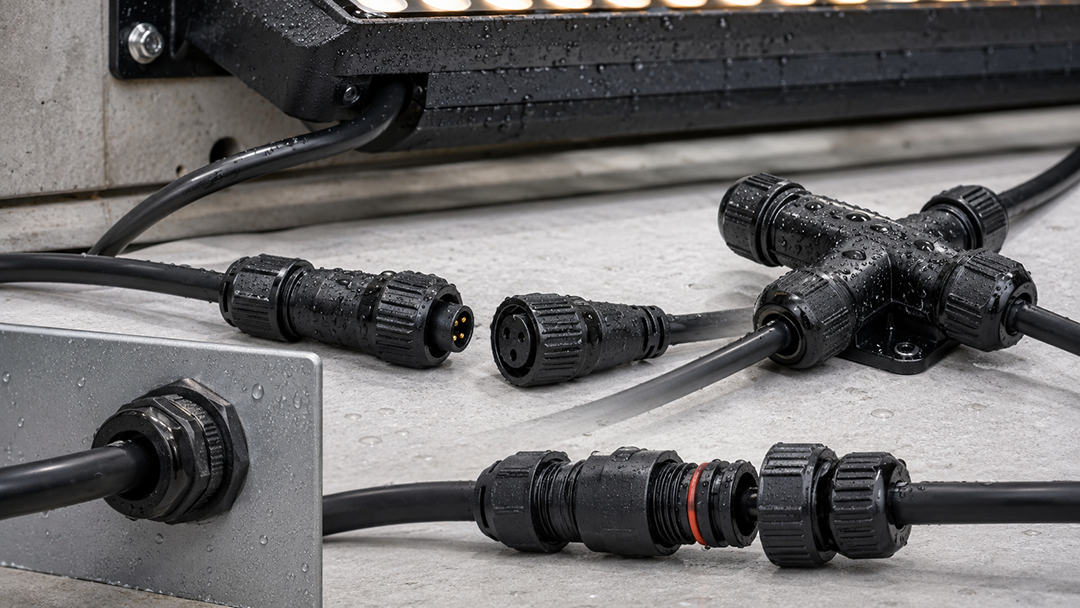
Once moisture enters the terminal area, oxidation can start. After oxidation, contact resistance increases. This may cause unstable voltage, abnormal signal transmission, flickering, color error, or local blackout.
For low-voltage LED facade systems, even a small problem at one connector can affect a full branch of lights. In SPI or DMX control systems, signal interruption at one point may influence many pixels behind it, depending on the wiring structure.
This is why professional project design should never treat connectors as small accessories. They are critical parts of the electrical and waterproof system.
Drainage Design Is Just as Important as Waterproofing
A common mistake in outdoor lighting projects is trying to seal everything without considering where the water will go.
Good waterproofing is not only about blocking water. It is also about guiding water away from sensitive positions.
If the curtain wall groove has no drainage path, water may stay around the lamp or connector for hours after rain. If the cable joint is located at the lowest point of the structure, it may be soaked repeatedly. If the connector is installed inside a narrow aluminum cavity, trapped humidity may create condensation even when there is no direct rain.
For high-rise building lighting, water movement is more complex than it looks. Rain can be pushed sideways by wind. Water can run down along glass, aluminum panels, steel structures, and cables. On some facades, the most dangerous point is not the surface exposed to rain, but the hidden cavity where water accumulates.
A reliable installation should avoid placing connectors in long-term wet areas. Where possible, connectors should be positioned with a downward-facing drip loop, away from water collection points, and accessible for future maintenance.
Before installation, the project team should check:
Where rainwater naturally flows
Whether the curtain wall has drainage holes
Where water may collect after heavy rain
Whether cable joints are located in dry or serviceable areas
Whether maintenance staff can reach key connectors later
Whether the cable direction prevents water from running into the joint
These details may look small, but they often decide whether the project remains stable after one rainy season.
Power and Signal Layout Also Affect Rain-Related Failures
Not every rain-related problem is purely waterproofing. Sometimes water exposes electrical design issues.
For example, when a connector becomes slightly oxidized, the voltage drop in that branch may increase. If the power supply margin is already too small, the result can be brightness loss or unstable operation. If the signal cable is too long, poorly shielded, or connected without proper direction control, moisture-related resistance changes can make the signal even more unstable.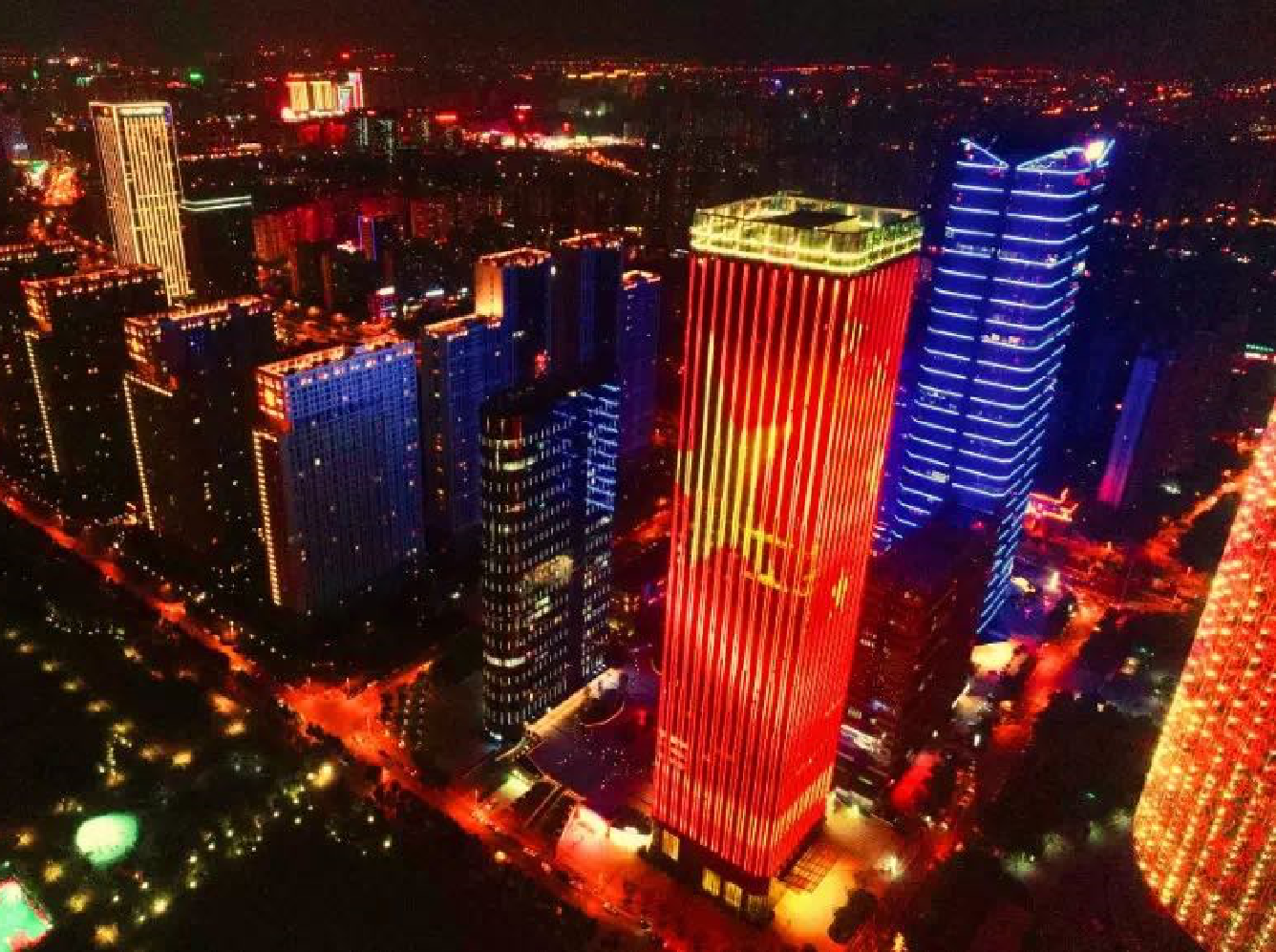
For large LED media facade projects, power and signal planning should be calculated before installation.
Important points include:
Voltage selection, such as DC24V or DC48V
Maximum load per power supply
Cable length and voltage drop
Number of pixels per controller port
Signal transmission distance
Power injection position
Branch circuit protection
Separate zoning for easier troubleshooting
Clear labeling for every cable, port, and power circuit
A good system design does not only make the lights work. It makes the project easier to test, maintain, and repair.
Why First Power-On Testing Is Not Enough
Many projects pass the first lighting test but still fail later. The reason is simple: first power-on only proves that the system works at that moment. It does not prove that the system is ready for outdoor conditions.
For outdoor LED facade lighting, testing should be done step by step.
Before powering on, technicians should check polarity, voltage, short circuit risk, cable direction, connector tightness, and whether the power branches match the wiring diagram. After that, the system should be powered on by sections, not all at once.
A professional commissioning process usually includes:
Visual inspection of all connectors and cable joints
Checking whether waterproof rings are correctly installed
Confirming positive and negative polarity before power-on
Testing each power branch separately
Checking output voltage at the beginning and end of the line
Running single-color tests: red, green, blue, white
Checking control signal direction and pixel sequence
Recording abnormal areas before final handover
Keeping circuit drawings and port tables for maintenance
For large projects, keeping documentation is extremely important. A facade may contain thousands or even hundreds of thousands of LED pixels. Without drawings, port tables, and circuit labels, later maintenance becomes blind troubleshooting.
How to Reduce Maintenance Cost Before the Project Is Finished
Outdoor facade lighting maintenance is expensive because the installation position is often difficult to access. A small connector problem on the ground may take only a few minutes to repair. The same problem on a high-rise curtain wall may require lifts, rope access, night work, traffic coordination, and multiple technicians.
That is why prevention is much cheaper than repair.
To reduce long-term maintenance cost, the project should consider the following points during the design and installation stage:
Use outdoor-grade waterproof connectors suitable for the project environment
Avoid cutting factory-molded cables on site unless absolutely necessary
Keep connectors away from water collection areas
Design cable routes with drip loops
Leave reasonable maintenance access
Use clear cable labels and port numbers
Do not overload controller ports or power supply branches
Test each zone before closing the facade structure
Keep spare products from the same batch for future replacement
Train installers before large-scale installation begins
For commercial buildings, lighting failure is not only a technical issue. It also affects the project image. A media facade with flickering zones or missing pixels can make the entire building look poorly managed, even if most of the system is still working.
A stable lighting system protects both the visual effect and the reputation of the project.
Our Recommendation for Outdoor LED Facade Projects
When choosing LED point lights, LED mesh screens, or linear facade lighting products for outdoor buildings, do not only compare brightness, pixel pitch, price, and IP rating.
Also ask these practical questions:
How are the connectors waterproofed?
Can the cable length and connector position be customized?
Is the product suitable for the building’s drainage structure?
How many pixels can one power branch safely support?
What is the recommended testing method before power-on?
Can the supplier provide wiring diagrams and maintenance documents?
Is there a clear installation guide for the contractor?
How will the system be repaired if one section fails later?
A professional supplier should not only sell the light. They should help you reduce project risk from the design stage.
Final Thoughts
Rain does not automatically mean an outdoor LED lighting project will fail. A well-designed system can operate reliably in rain, humidity, heat, cold, and long-term outdoor conditions.
But rain is very good at exposing weak points.
In many real projects, the problem is not simply “the lamp is not waterproof.” The real risk may be a loose connector, a wrong cable direction, poor drainage, an overloaded power branch, or incomplete testing before handover.
Outdoor LED facade lighting is a system project. The product quality matters, but installation design and construction details matter just as much.
If the connector, wiring, drainage, power supply, and control system are handled correctly from the beginning, the project will be far more stable after rain—and much easier to maintain in the future.